Founded in April 2024, the Fluid Production Systems Laboratory places a strong emphasis on industry–academia collaboration and international engagement. All research themes are related to the automotive domain and are advanced in partnership with five companies.
Our primary focus is experiments and modeling of multiphase flow phenomena (gas–liquid and solid–liquid two-phase flows), aiming to generate knowledge that contributes to high-speed polishing processes and the advancement of electric vehicles. We are also engaged in vehicle-dynamics modeling and in the development of industrial IoT technologies by leveraging networking technologies and data science.
Related fields: Fluid Engineering · Manufacturing Engineering · Physics
Main Alumni Universities
Kyushu Institute of Technology(Japan)
Anhui University of Science and Technology(China)
Yokohama National University(Japan)
Universidad de Monterrey (Mexico)
Hanoi University of Science and Technology(Vietnam)
*If you are interested in joining as a research student, please email me your CV.
email: fujisawa-kei-bdアットynu.ac.jp
Master’s Program / Doctoral Program
*If you are interested in joining as a PhD student, please email me your CV.
*If you are interested in scholarships, please feel free to contact me.
Master’s Program / Doctoral Program
Main Research
Kei Fujisawa (Associate Professor, Department of System Design, Graduate School of Engineering, Yokohama National University)
Research student: 1 student(India)
Master 2st Year: 3 students
Master 1st Year: 1 student
Research student: 1 student(China)
Undergraduate 4th Year: 4 students
* Our laboratory is always open to new members, both internal and external. We study together from the basics, so even those who have never studied manufacturing engineering or fluid engineering are welcome. Faculty and collaborators also provide extensive experimental support. A large new project is starting, so if you are interested, please contact us!
We actively engage in joint research with universities and research institutes in Japan and abroad.
For Companies & Research Institutes
We accept laboratory visits at any time for students wishing to be assigned here for undergraduate or graduate study. International students and applicants from other universities are also welcome, so feel free to contact us. To date, we have accepted students from other universities as well as from Mexico and Vietnam. Leveraging the faculty’s overseas experience, we also actively dispatch students abroad to countries such as India, Australia, the United States, and Denmark!
Due to the nature of our research topics, it may be necessary to change approaches as the work progresses. Flexibility in responding to unpredictable changes is required. Therefore, this laboratory is recommended for people who can think flexibly without falling into black-and-white thinking. Let’s pioneer new fields together!
* Because our laboratory actively conducts joint research with domestic and international research institutions, universities, and private companies, teamwork is sometimes necessary. We value cooperation and flexibility that enables collaboration with research partners, faculty, and engineers in industry. Students who have a strong insistence that "my research must be done only in this way" may not fit well with our philosophy.
Meetings are held weekly or bi-weekly (about 15 minutes each) for each research theme. Although the frequency is low, we also hold discussions with collaborators and engineers from private companies. Viewing your research from various perspectives broadens your horizons.
We hold a study group called the "Paper Seminar" for new students in April and May. Each student reads and presents materials and papers related to their theme. We learn together by reading explanatory slides created by the laboratory (updated annually) with senior students, so even those who are not good at reading papers are fine! Let’s study together!
To deepen understanding of the research, we plan to hold presentations three times a year in collaboration with other laboratories in the Control, Mechatronics & Robotics group. Through meetings, paper seminars, and presentations, we provide an environment where you can feel your growth.
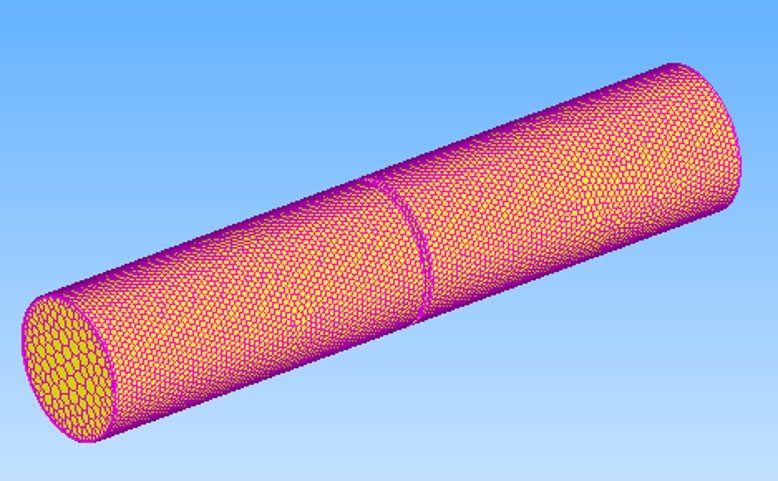
We are also focusing on bubble-control technologies for liquid flows containing bubbles of various sizes. In particular, we study oil flow in piping systems with an orifice. Although the inlet Reynolds number is around 1,000, the local Reynolds number can exceed 10,000 near the restriction. We are interested in incompressible flows with multiple bubbles (rather than single-bubble dynamics) and aim to elucidate the underlying phenomena through simulations to enable robust bubble control across different bubble scales.
(in collaboration with companies and universities).
This is our central research theme.
Main software: scFLOW, AutoCAD
Because collaboration with companies and universities is necessary, this theme is recommended for those who enjoy communication. Let's take on the challenge together!
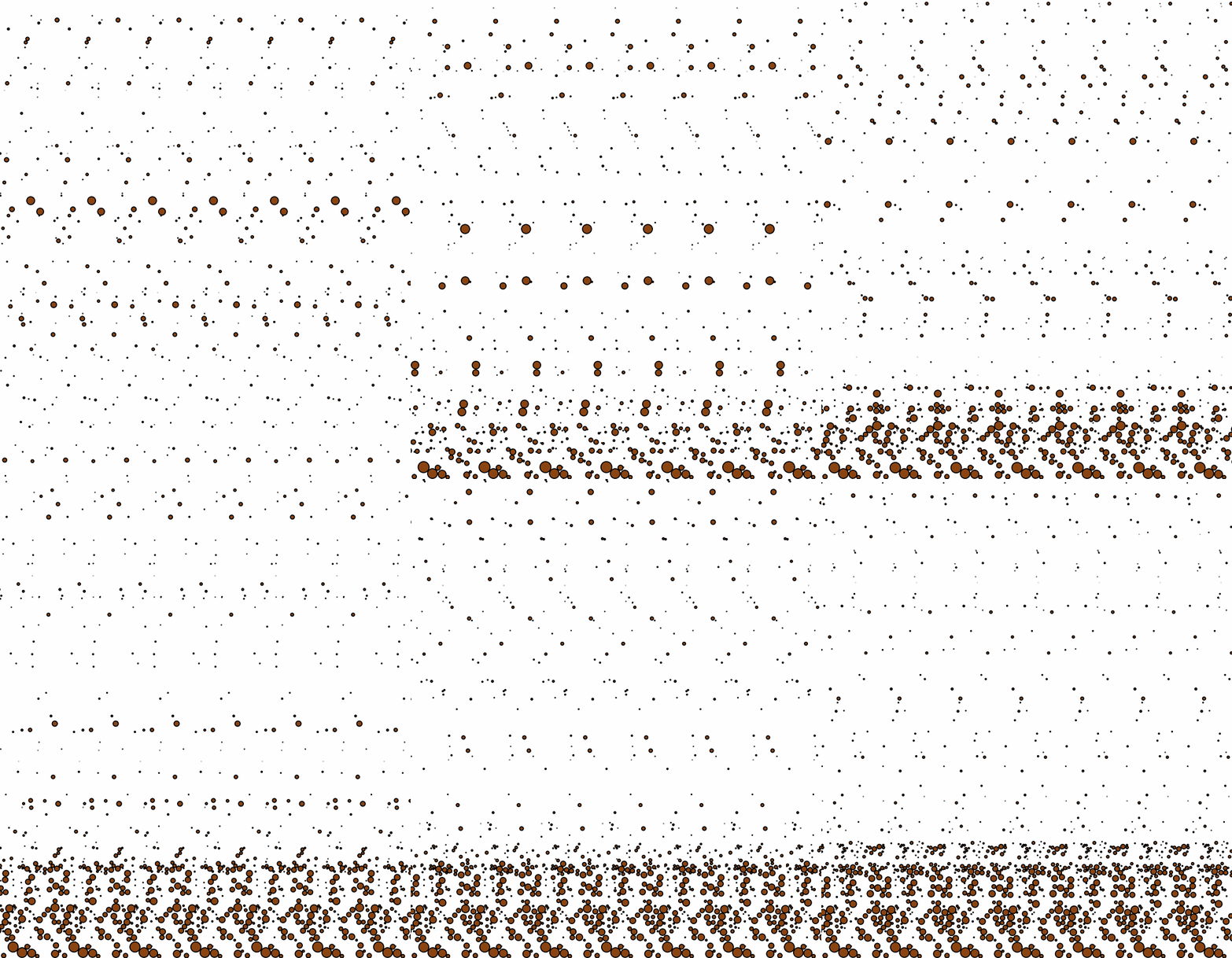
We investigate sedimentation phenomena of solid particles in highly viscous, incompressible fluids using CFD-based multiphase-flow modeling. Our interest includes concentration effects (hindered settling), particle–particle and particle–wall interactions, and the formation of clusters and stratified layers in confined geometries. Through simulations, we aim to clarify the governing mechanisms and establish predictive models to control deposition and suspension behavior in practical engineering systems.
This is one of our key research themes.
Main software: scFLOW, AutoCAD
We study cavitating flows in water, focusing on the coupled phenomena of cavitation, vapor–liquid phase change, and bubble breakup in high-shear regions (e.g., near restrictions and locally accelerated flows). Using CFD with cavitation/phase-change modeling, we aim to clarify how vapor bubbles nucleate, grow, fragment, and collapse, and how these processes influence pressure fluctuations, flow structures, and two-phase characteristics. Our goal is to build predictive simulation frameworks for robust design and control of cavitating two-phase flows.
This is one of our key research themes.
Main keywords: CFD, cavitation, bubble breakup, two-phase flow, phase change, vapor flow
Main software: scFLOW, AutoCAD
April Laboratory assignment / Welcome party
April Paper Seminar
June B4 Preliminary Interim Presentation (joint with other laboratories)
August Graduate entrance examination / Summer break
August Summer break
October B4 Interim Presentation
January New Year holiday
February Undergraduate thesis presentations
March Graduation trip / Spring break
*Saturdays, Sundays, and public holidays off
Anhui University of Science and Technology